Do you struggle to give concise answers to interview questions?
Are you unsure how to share your accomplishments during an interview without
sounding boastful? Or too modest?
Most employers will try to connect past and future behaviour, so in the interview process they will attempt to assess your future performance by enquiring about your past behaviour and actions. Behavioural based questions simply ask what you have done in the past. It is useful to be aware that your responses will be hypothetically critiqued against future anticipated behaviours.
The most common method for responding to behavioural based questions is
the ‘STAR’ method and often an interviewer, particularly those with a Human
Resources background will expect you to answer questions in this format or a
similar variant.
The ‘STAR’ methodology is a structured manner of responding to
competency/behavioural-based questions by providing examples of a Situation and
Tasks you were required to undertake, Actions you took and the Result that was
achieved. This method focusses your brain and allows you to provide
concrete examples or proof that you possess the experience and skills for the
job at hand.
Prior to the interview, it may help to read the job description and make
a list of the skills and experiences that are required for the role. Have
examples on the tip of your tongue of past experiences that match your
qualifications to those listed in the posting. When preparing for an interview,
trigger your brain to go into STAR mode if you hear a question starting with
phrases such as, “Describe a time when…” and “Share an example
of a situation where….”
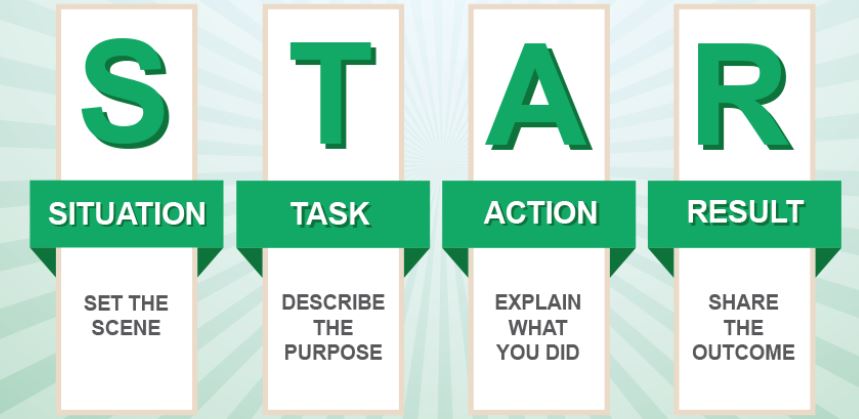
The concepts of the STAR acronym comprise the following:
Situation– Briefly and concisely describe the situation to give context to your task, include when this occurred and highlight any resources that were available to you and any existing challenges. Provide an example of a situation from your past which you could foresee arising in the role you’re being interviewed for.
Task – Clearly
define what your responsibilities were, what you were required to achieve and the
timeframe you had to work within.
Action
– Give a detailed description of not only what you did but why you did it
covering the other options that would have been available to you that were not
selected. Emphasise the skills and knowledge utilised to complete task.
Results – Provide a
concise evaluation of the result and also be sure to include what you learnt
from the experience and how this has affected your decision making since the
event. The result should preferably be a positive one!
Examples – using the STAR method
Example Question 1: Have you ever been in a situation when
a team member has not completed his or her quota of the work?
Example Answer 1: When there are team conflicts or issues, I
try my best to step up as team leader if needed. I think my communication
skills make me an effective leader and moderator.
For example, once I was the wicketkeeper of the Tasmanian
cricket team and I was unexpectedly called up to captain the Australian
national team after the regular captain and vice captain got embroiled in
a scandal, both unable to complete their assignments (SITUATION). As I was now leading
the project and ultimately responsible for meeting the expectations of the
Board (TASK), I arranged a team meeting where we reallocated all the
assignments among the team members and formulated a new set of expected
behaviours (ACTION). This made everyone more productive and the team culture
improved dramatically. Our project culminated in a successful team, winning the
series against Sri Lanka two nil (RESULT).
Example Question 2: Tell me about a time you showed initiative on the job.
Example Answer 2: Last year I was working as second in charge
of the commanding army. War was imminent and we were about to go into battle
for control of my spiritual and ancestral homeland. My commanding officer was
stubborn in his belief that even though we were undermanned we would be
successful in defeating our enemies. I wasn’t so sure (SITUATION). My
responsibilities were to assemble the troops and prepare them for battle
(TASK).
I took it upon myself to send a raven to former allies, requesting
their services and thereby increasing the size of our army exponentially (ACTION). As
our commanding officer’s troops were being trampled and our future appeared
doomed, a horn sounded and our reinforcements (the Knights of the Vale) arrived
in the nick of time. We casually swept away the enemy forces, winning the
battle and allowing me to claim my rightful title as the Lady of Winterfell (RESULT).
When
you’re searching for a new job, it’s difficult to establish
exactly what you should be doing to portray yourself as the most
credible candidate to potential employers. With employers all wanting
different things from their new recruits, how can you make sure
you’re ticking their boxes?
When
you have the right strategy, however, the task can become a lot more
straightforward. Having a plan can boost your confidence, which will
then put you in the best frame of mind for your job search.
Specialise
your skills
LinkedIn’s
Job Search Guide recommends
that in order to turn your future role into “more than just a job”,
you should specialise. The guide advises job seekers to make a list
of their skills and to “know where they can take you”. It then
says to “uncover what you’re best at and continue to hone those
skills throughout your career”.
Working
to specialise in a certain area will help to ensure that you are
limiting your focus to jobs you actually want, rather than something
to simply tide you over. It then becomes easier to share your passion
for your industry, which will come across to hiring managers.
Employers will then likely see you as more dedicated to your chosen
career, which can give you an advantage over other candidates.
If
you chose to develop a highly valued and in-demand skill, you’ll
give yourself even more chance of landing your dream role. This is
highly relevant right now, since there’s a serious skills gap in
many markets across the world.
Plan
your progress
Do
you have a well thought-out answer to the common job interview
question of where you see yourself in a few years? Planning out your
career progress will help you come up with an honest answer,
something that a lot of other candidates won’t be able to offer.
Setting
out the milestones you think you should hit in your career can help
you work out exactly which opportunities are right for you. LinkedIn
recommends setting up a six-month, 12-month and two-year plan
describing how you want your career path to go. Holding yourself
accountable will help to ensure you are working towards your ultimate
goal.
It
will also provide you with a framework for evaluation. Have you not
reached your goals for your two-year plan? Then it’s time to do
something about that – whether that’s having a frank discussion
with your manager or looking elsewhere for an opportunity that will
allow you to reach the targets you’ve set yourself.
Optimise
your application materials
Job
applications need to be as tailored as possible, making it unique to
the opportunity available. This serves to explicitly align your
skills and experience to the role on offer. It will serve you well in
getting through any automated application systems the company uses as
well as making it easy for the hiring manager to decide who to call
in for an interview.
However,
your LinkedIn
profile doesn’t have to be as tailored.
This is one arena where you can elaborate on what you’ve done in
the past. Share your accomplishments, your portfolio and any work
you’ve done that will highlight your employability.
Make
sure you use the right keywords on both your job applications and
LinkedIn profiles. The former will also help to get you through any
applicant tracking system, while the latter will boost your chances
of appearing in any searches for that keyword. LinkedIn’s Job
Search Guide explains: “It’s a living resume more than a
statement of skills. Put this organism to work by optimising your
profile.”
Be
honest about what you know
Ensuring
you’re upfront about what you know and what you don’t will
prevent you getting yourself into a situation that could cause
problems for both you and your employer. Have you heard stories of
people who have claimed they could do something in their application
to be confronted with that situation and aren’t able to deliver on
it?
The
Balance has reiterated how important it is to be honest in
a job application, saying “if you’re not honest, it’s going to be
an issue for potential employers”. Any possible awkwardness you
might feel when being honest about something you don’t know will be
outweighed by being found out to have lied.
If
you’re worried about not looking knowledgeable enough in an
interview, there’s a way of turning it into a positive. Be the
first to bring up your lack of familiarity with something, and
explain that you’re eager to overcome this and learn about the
subject. Highlight previous instances where you’ve had to learn
about something and completely mastered the topic. This will give a
hiring manager some assurance that you’re capable of doing the job.